The Textile Mills of Lawrence, Mass.
In the second half of the nineteenth and first half of the twentieth centuries, Lawrence, Mass., was a textile mill town, specifically a woolen and worsted mill town /1/. The terms woolen and worsted refer to the two major divisions of wool processing prior to spinning into yarn. Wool that has been carded to align the fibers for spinning produces a somewhat loose yarn with a noticeable "hairiness." These woolen yarns are used for tweeds, for overcoats, and jackets and blazers, as well as for blankets. Fiber that has undergone combing and other further processes beyond carding is used for the spinning of worsted yarns. Worsted yarn is very tight and smooth and typically is used for men's suits and trousers and ladies' dresses.The nearby Merrimack River Valley mill town of Lowell, Mass. was the place where cotton was "king," nevertheless, Lawrence had a number of cotton mills as well as silk manufacturers and dyers and finishers.
The textile mills drew heavily on immigrant labor, as noted in this 1913 report to the National Ass'n. of Cotton Manufacturers.
The descriptions below of the Lawrence mills are adapted from Davison's Textile Blue-Book for 1928.
Acadia Mills
A knitter and weaver of cotton yarn, incorporated 1917, employing 1,100 workers.
American Woolen Company
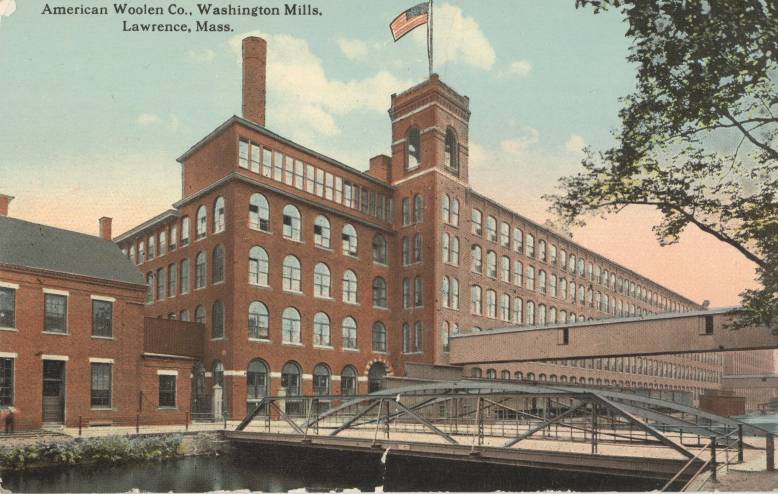
A complex of several mills /2/, including:
|
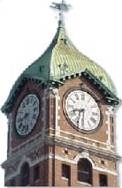
| Ayer Mill Clock Tower, Lawrence, Mass. |
- Ayer Mill on South Union Street produced worsted fabrics for menswear.
According to MassInnovation LLC (retrieved August 25, 2007)
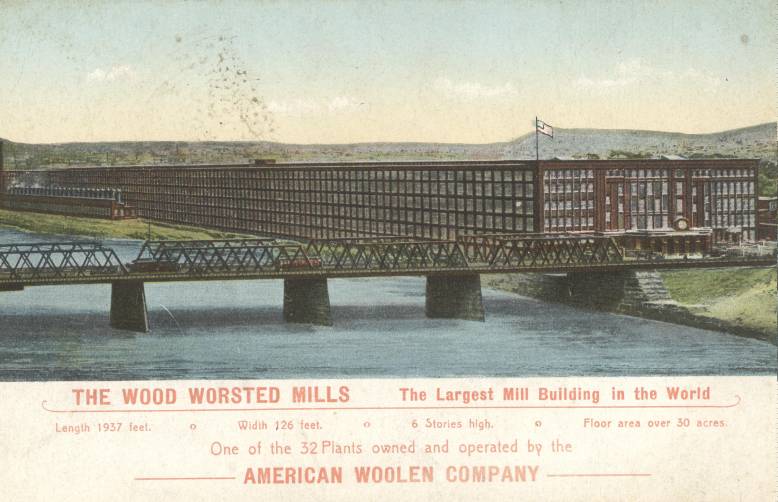
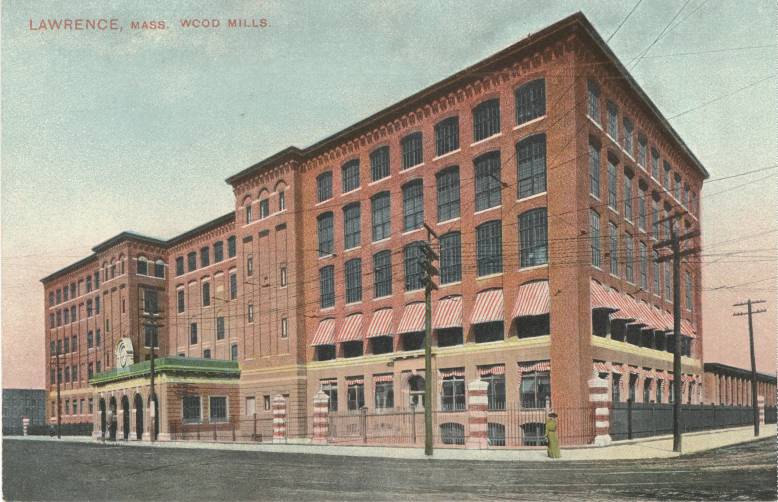
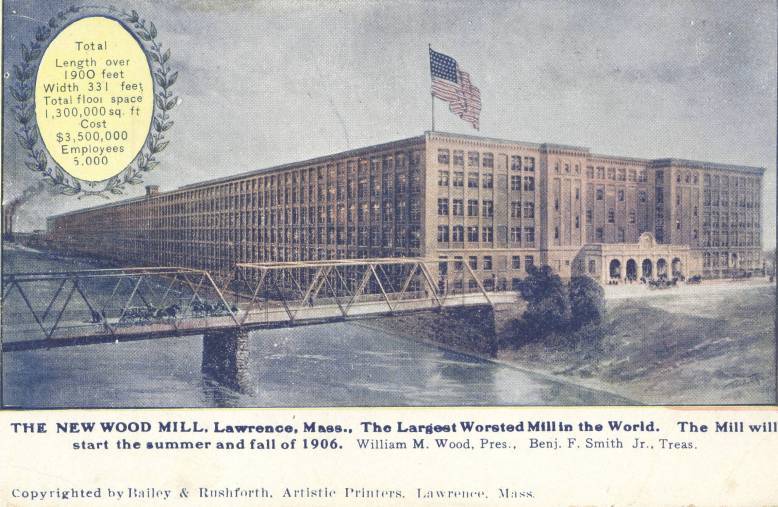
"At over 1.3 million square feet, the Worsted Wood Mill is the largest original mill building standing in Lawrence."
and "the clocktower is the second largest in the world (after Big Ben)."
- Prospect Mill was a yarn spinner and employed 200 workers.
|
|
|
|
|
Arlington Mills
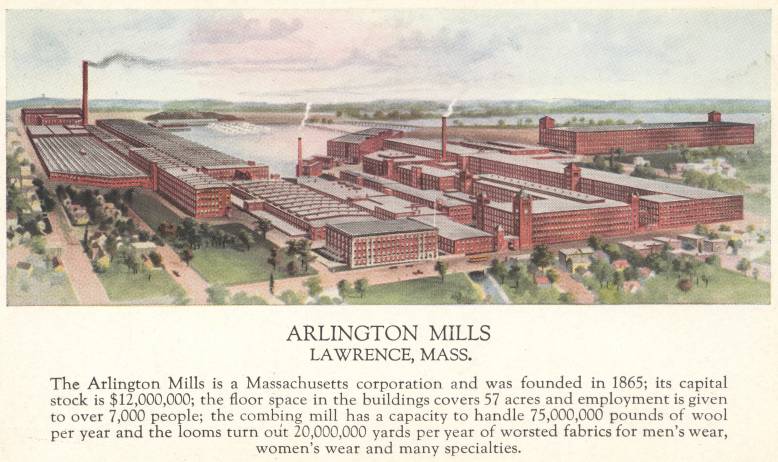
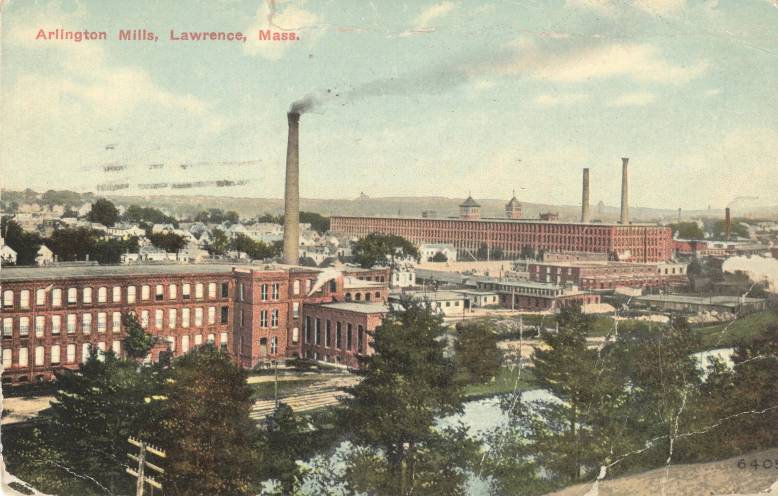
Preparation of wool for worsted spinning, worsted spinning, and fabric weaving. In 1956 Malden Mills, a knitter, (now known as Polartec) relocated to the Arlington Mills complex which was subsequenlty razed in a December 11, 1995 fire; new buildings have been erected on the site.
John W. Barlow Co.
75 Holly St. Webbings, tapes, and belting; est. 1865.
Henry Bauer
616 Essex St. Fancy corset cloth, jacquard, broad silks, cotton and silk goods and trim; est. 1914; 27 workers.
Wm. & Chas. Beck
83 Holly St. Linen fire hose; incorporated 1921.
Emmons Loom Harness Co
7 May St. Loom harness and reeds [textile machinery supplies]; est. 1865.
Everett Mills
Union St. at foot of Essex. Ginghams, fine shirtings, denims, etc.; incorporated 1860.
Gurnet Mills
Union St., weaving, dying and finishing of woolen and worsted fabrics for men's and women's wear. Employed 75 workers.
Farwell Bleachery
Bleach, mercerize, and dye cotton and silk; incorporated 1886; 350 workers.
Katama Mills
So. Union St. Broad looms (weaving of cotton); idle April 1928.
Henry Klous Co.
Processing of waste and recycled wool.
George E. Kunhardt Corp.
Corner of Union and Island Sts., weaving of woolen and worsted fabrics for men's wear. Employed 800 workers.
Lawrence Burling & Sewing Co.
19 Oxford St., commission mending, burling, and sewing (common operations to mend defects in new woven cloth prior to shipping to customer).
Lawrence Duck Co.
Paper mill felts.
Lawrence Industrial School
(Destroyed by fire, January 1928; to be rebuilt.)
E. Frank Lewis
So. Canal St. Wool scouring and carbonizing.
McKenna & Bobbins
620 Essex St. Cotton and silk corset cloth; est. 1921.
Monomac Spinning
So. Union St., spinning of worsted yarns for weaving and knitting, also spinning of silk yarn.
Mulvey Yarn & Dyeing Co.
45 Brook St. Dye cotton, wool, and silk yarns and raw stock.
|
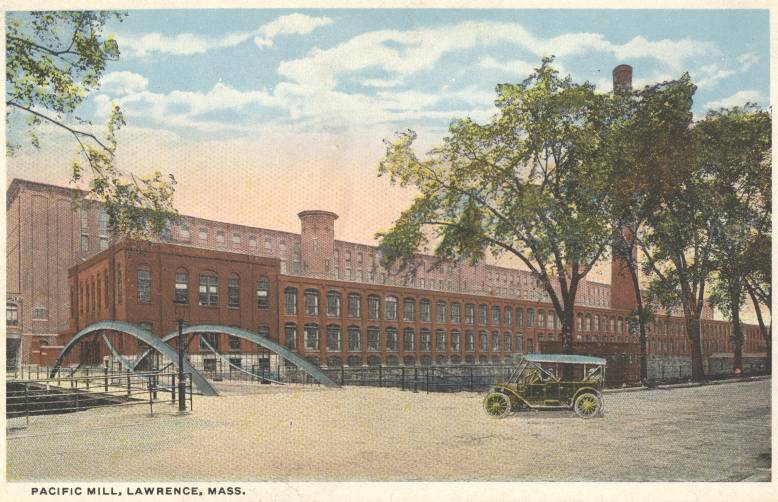
|

|
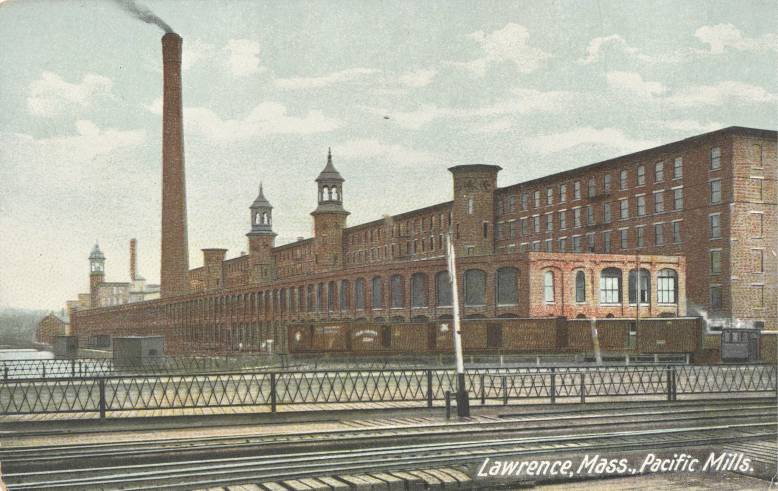
Postmarked 1906. |
Pacific Mill, Lawrence Mass.
Preparation of wool and weaving of worsted fabrics for dress goods, 3,800 workers; prints and fancy cottons, 1,000 workers. Est. 1853.
Permberton Co.
Canal St. Glazed cotton wadding; ect. 1860.
Wm. Stuart & Co.
88 Vine St. Dyers of cotton and woolen yarns, braids, and tapes; 20 workers.
United States Worsted Corp.
South Broadway, weaving and finishing of fabric for men's wear and dress goods. (Note, mill was idle 1927-28).
Walworth Bros.
Merrimack St., weaver of ladies worsted dress goods.
Unidentified textile mill.
NOTES:
/1/
According to the book Lawrence, Massachusetts (Acadia Publishing, 1995) With worsted's growth in popularity and the building of the huge Wood and Ayer Mills in the early
1900s, it wasn't long until Lawrence became the woolen and worsted center of the world. Even
children were proud of that distinction; "We Weave he World's Worsted"
became a familiar phrase in schools around the city.
/2/
According to Wikipedia (retrieved August 25, 2007)
The American Woolen Company was established in 1899 under the leadership of William M. Wood and his father-in-law Frederick Ayer
through the consolidation of eight financially troubled New England woolen mills.
At the company's height in the 1920s, it owned and operated 60 woolen mills across New England. It is most known for its role in the Lawrence textile strike of 1912.
Frederick Ayer, successful Lowell merchant, purchased the Washington Mills in Lawrence, Massachusetts and hired his son-in-law, William M. Wood to run it.
Wood had already successfully turned around a bankrupt mill in Fall River. With Ayer's financial backing, Wood brought together various under-performing
mills in the aim of reducing competition and increasing prices. He convinced investors to permit profits to be reinvested into new plants and machinery.
Wood also continued a trend of hiring immigrant labor to save costs. In 1905, the American Woolen Company built the largest mill in the world, the Wood Mill in Lawrence,
followed by the neighboring Ayer Mill.
/3/
A National Trust for Historic Preservation in 2008 Honor Award recognized the conversion of Washington Mills Building No 1 to mixed-income housing, noting
Built in the 1886, Washington Mills Building No. 1 is a key building in the North Canal National Historic District. It is also a part of the Reviviendo Gateway Overlay Zoning District, which allows for residential use in the former industrial corridor. Washington Mills was deteriorating and almost completely vacant when it was renovated with funding from public and private sources, including state and federal tax credits. The $40 million, 17-month redevelopment transformed the 240,000-square-foot building. The rehabbed mill now provides 155 units of mixed-income housing, employing design features that showcase the building's industrial character. Ranging in size from 625 to 1,700 square feet, the lofts' architectural highlights include soaring 14-foot-high ceilings, nine-foot arched windows and exposed brick walls.